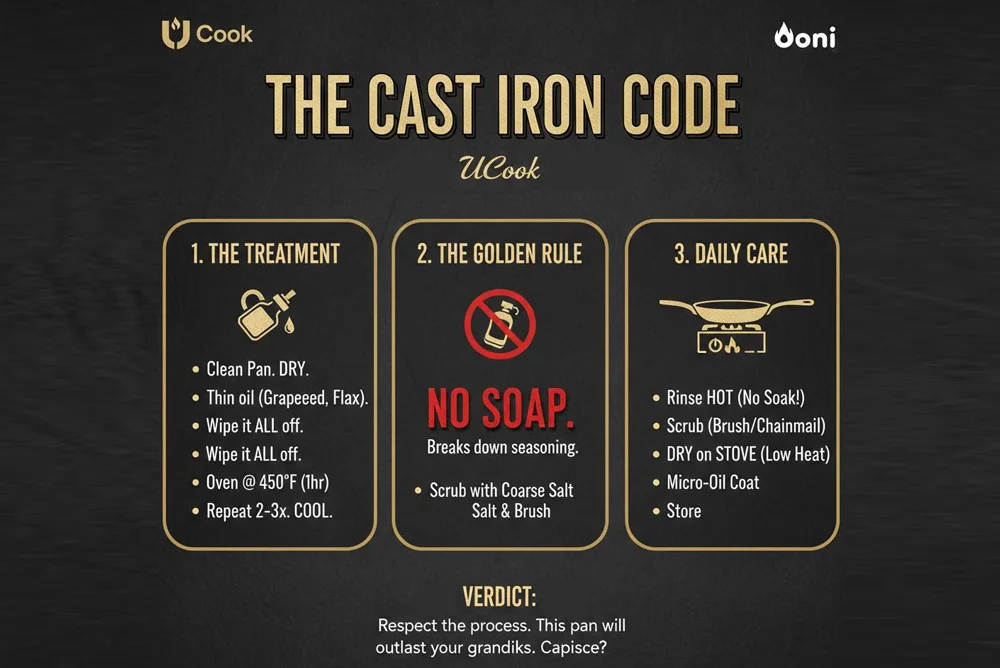
In this business, we respect things that last. A cheap, plastic-coated pan from a big-box store is a “disposable.” It’s a temporary fix. But a Cast Iron Skillet? That’s an heirloom. That’s a legacy. If you treat it right, that pan will be cooking steaks for your grandkids long after you’ve cashed out.
But here’s the thing: Cast iron requires a certain understanding. You don’t just throw it in the dishwasher and hope for the best. You follow The Code.
1. The Treatment (Seasoning Your Pan)
“Seasoning” isn’t about salt and pepper; it’s about polymerization. You’re bonding oil to the metal to create a natural, non-stick surface that’s tough as nails.
- The Oil: Don’t use butter or olive oil for this—they burn too low. You want a high-smoke point oil like grapeseed, flaxseed, or canola.
- The Coating: Rub a very thin layer of oil all over the pan (inside, outside, and the handle). Now, take a clean paper towel and try to rub it all off. You want a microscopic layer, not a greasy mess.
- The Heat: Put the pan upside down in your oven at 450°F ($232°C$) for one hour. Let it cool down inside the oven.
- The Repeat: Do this 2 or 3 times for a new pan, and you’ll have a finish as black and slick as a fresh asphalt road.
2. The Golden Rule: Forget the Soap
There’s a lot of talk out there saying “a little soap is fine.” Listen to us: Just don’t do it. Soap is designed to break down grease and oil. Your seasoning is oil. Why would you bring a snitch into the room? If you’ve got stuck-on bits, use coarse salt and a stiff brush. The salt acts as an abrasive to “clean up the evidence” without whacking your seasoning.
3. The After-Action Report (Daily Care)
Once the job is done and the meal is served, don’t let that pan soak in the sink. Moisture is the “rat” that brings the rust.
- Rinse with hot water while the pan is still warm.
- Scrub with a chainmail scrubber or stiff brush (No soap!).
- Dry Immediately. Put it back on the stove over low heat for a minute to make sure every drop of moisture is evaporated.
- The Final Touch: Rub a tiny drop of oil onto the cooking surface before you put it away. It’s like a fresh coat of wax on a getaway car.
4. What if It Starts to Rust?
If you find a “rusty” pan at a garage sale or you left yours in the rain, don’t panic. It’s not dead; it just needs a “re-education.” Scrub the rust off with steel wool, get it down to the raw metal, and start The Treatment from Step 1. Cast iron is the only piece of gear that gets better the more you use it.
The Verdict: Treat your cast iron like a Made Man. Give it respect, keep it clean (but not soapy clean), and it will never let you down when the heat is on.
Want to see the Code in action? Come down to a UCook class and see how we use seasoned cast iron and Ooni steel to get that perfect sear every time.